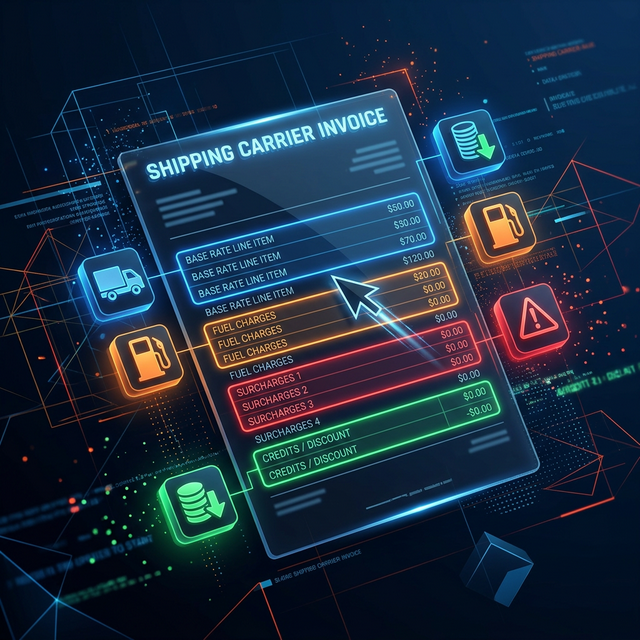
Why Invoice Literacy Matters
Your carrier invoice is the single most important document in shipping cost management. It tells you exactly what you’re paying, for what services, and why. Yet most shippers glance at the total and pay without examining the details.
Billing errors are more common than you’d think — industry estimates suggest 2–5% of carrier invoices contain errors in the carrier’s favor. You can’t catch what you can’t read.
The Structure of a Carrier Invoice
Both UPS and FedEx invoices follow a similar structure, though the formatting differs:
Invoice Header
- Account number: Your carrier account identifier
- Invoice number: Unique identifier for this billing period
- Invoice date: When the invoice was generated
- Payment terms: Typically Net 15 or Net 30
- Billing period: The date range covered (usually one week)
Shipment Detail Section
Each shipment on the invoice includes:
| Field | Description |
|---|---|
| Tracking number | Unique shipment identifier |
| Ship date | When the package was picked up |
| Delivery date | When (and if) the package was delivered |
| Service | The service level used (Ground, NDA, 2DA, etc.) |
| Origin zip | Where the package was shipped from |
| Destination zip | Where the package was delivered |
| Weight | Billable weight (actual or DIM, whichever is greater) |
| Zone | The zone assigned based on origin-destination |
| Dimensions | Package measurements (L × W × H) — not always shown |
Charge Breakdown
For each shipment, charges are itemized:
- Transportation charge: The base rate from the rate table
- Fuel surcharge: Percentage of the transportation charge
- Residential delivery: Flat fee if delivered to a residence
- Delivery area surcharge: If destination is in a DAS zip code
- Additional handling: If package exceeds size/weight thresholds
- Other surcharges: Signature, address correction, peak, etc.
- Taxes: Sales tax where applicable
How to Read UPS Invoice Charge Codes
UPS uses specific charge description codes on invoices:
| Charge Code | Description |
|---|---|
| SHP | Base transportation (shipping) charge |
| FSC | Fuel surcharge |
| RES | Residential delivery surcharge |
| DAS | Delivery area surcharge |
| EAS | Extended area surcharge |
| AHS | Additional handling surcharge |
| ADC | Address correction charge |
| SAT | Saturday delivery charge |
| SIG | Signature required charge |
| DV | Declared value (insurance) charge |
| PKP | Peak/demand surcharge |
| ADJ | Adjustment (credit or debit) |
How to Read FedEx Invoice Charge Codes
FedEx invoices use slightly different terminology:
| Charge Code | Description |
|---|---|
| Transportation | Base shipping charge |
| Fuel | Fuel surcharge |
| Residential Delivery | Home delivery surcharge |
| Delivery Area | DAS surcharge |
| Additional Handling | AHS charges (weight, dimensions, packaging) |
| Address Correction | Invalid address correction fee |
| Signature Option | Direct/indirect/adult signature fee |
| Declared Value | Insurance/declared value charge |
| Peak Surcharge | Holiday peak surcharge |
Understanding Adjustments and Credits
Carrier invoices frequently include adjustment lines — charges that were modified after the initial billing:
Common Adjustment Types
- Weight/dimension correction: The carrier re-measured your package and adjusted the billable weight. This is the most common adjustment and usually results in a higher charge.
- Address correction: The carrier changed the delivery address and added an address correction fee.
- DAS reclassification: The package was reclassified as a Delivery Area Surcharge delivery after initial billing.
- Service guarantee credit: A refund for a late delivery under the carrier’s money-back guarantee.
- Void credit: Credit for unused/voided shipping labels.
Red Flags to Watch For
When reviewing your invoice, look for these common issues:
1. DIM Weight Overcharges
Check that the dimensions listed match your actual packaging. Carrier dimension scanners can occasionally overstate measurements, inflating DIM weight.
2. Duplicate Charges
The same tracking number appearing twice with identical charges is a billing error that should be credited.
3. Incorrect Service Level
A package shipped as Ground but billed as 2nd Day Air. This happens more often with redirected or rerouted packages.
4. Missing Contract Discounts
Verify that your negotiated discount percentage is being applied correctly to the base rate. Occasionally, new account setups or system changes cause discounts to drop off.
5. Residential Misclassification
Business addresses incorrectly classified as residential, triggering a $6.95 surcharge. This often happens with home-based businesses or commercial addresses in residential neighborhoods.
6. Late Delivery Without Credit
Under the carrier’s Service Guarantee (if active), late deliveries should receive automatic credits. Many shippers don’t claim these.
Automating Invoice Review
Manual invoice auditing is time-consuming and error-prone at scale. Most businesses shipping more than 500 packages per week benefit from automated audit tools that:
- Flag billing errors and overcharges
- Track surcharge trends over time
- Identify late delivery refund opportunities
- Monitor contract compliance
The Bottom Line
Your carrier invoice is more than a bill — it’s a data source. Learning to read it gives you the ability to catch errors, understand your cost structure, and negotiate improvements. At a minimum, review the surcharge breakdown and weight/dimension adjustments on every invoice. The 2–5% of charges that contain errors add up quickly at scale.
Don’t have time to audit invoices manually? Upload one to ShipMint’s Instant Analysis and get an automated cost breakdown with error detection — free.