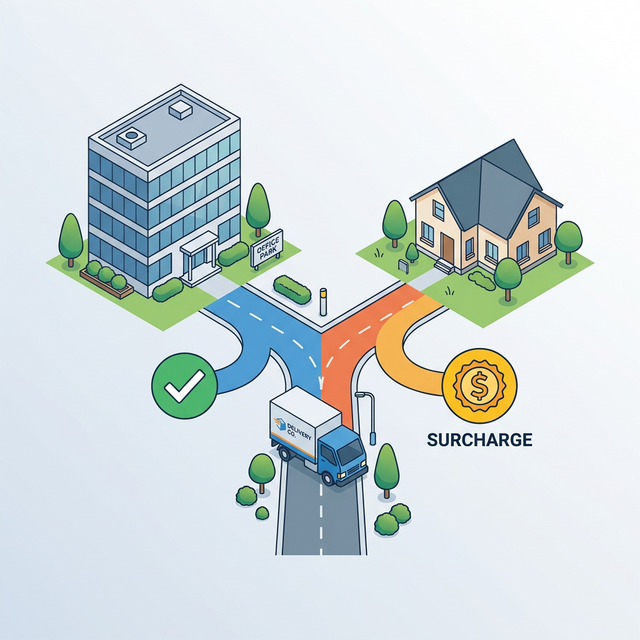
What Is the Residential Delivery Surcharge?
The residential delivery surcharge is a per-package fee that UPS and FedEx apply whenever a package is delivered to a home address rather than a business location. In 2026, this surcharge is:
| Carrier | Service | Residential Surcharge |
|---|---|---|
| UPS | Ground / Air | $6.45 |
| FedEx | Ground / Express | $6.95 |
| FedEx | International Ground (Canada) | $6.95 |
This surcharge is applied in addition to the base transportation charge, fuel surcharge, and any other applicable fees. For high-volume e-commerce shippers, it can represent 15–25% of total shipping costs.
Why Do Carriers Charge More for Residential Delivery?
Residential deliveries are fundamentally more expensive for carriers to execute than commercial deliveries:
- Lower density: Homes are spread out, meaning more stops per mile with fewer packages per stop
- Access challenges: Driveways, gates, apartment buildings, and no loading docks
- Redelivery rates: Higher failed first-attempt rates compared to businesses
- Extended hours: Residential deliveries often require evening or weekend attempts
Commercial routes, by contrast, feature clustered drop-offs at office parks and retail centers with predictable receiving hours and dock access.
How Carriers Classify Addresses
This is where it gets tricky. Carriers don’t rely on what you declare — they use their own address classification databases to determine whether a destination is residential or commercial.
Both UPS and FedEx maintain databases that classify every deliverable U.S. address. These databases are updated regularly but aren’t perfect:
Common Misclassification Scenarios
| Scenario | Your Intent | Carrier Classification | Result |
|---|---|---|---|
| Home-based business | Commercial | Residential | Surcharge applied |
| Retail store in mixed-use building | Commercial | Sometimes residential | Surcharge may apply |
| Office in residential neighborhood | Commercial | Sometimes residential | Surcharge may apply |
| Apartment complex leasing office | Commercial | Residential | Surcharge applied |
Misclassifications happen frequently. If your invoice shows residential surcharges on addresses you know are commercial, you can dispute them — but the carrier’s database typically takes precedence.
The Impact on E-Commerce Shippers
For B2C (business-to-consumer) shippers, the residential surcharge is essentially unavoidable on most orders. Consider the math:
Scenario: 5,000 packages/month, 85% residential
- Residential packages: 4,250
- Surcharge per package (FedEx): $6.95
- Monthly residential surcharge cost: $29,537
- Annual cost: $354,450
That’s more than a third of a million dollars per year — just for the residential surcharge — on a relatively modest shipping volume.
How to Reduce Residential Surcharge Costs
1. Negotiate the Surcharge Down
Residential delivery surcharges are negotiable in carrier agreements. High-volume shippers can often reduce them:
| Volume Tier | Typical Negotiated Rate | Savings vs. Published |
|---|---|---|
| 1,000+ pkgs/week | $5.50–$6.00 | 14–21% |
| 5,000+ pkgs/week | $4.00–$5.00 | 28–42% |
| 10,000+ pkgs/week | $3.00–$4.50 | 35–57% |
2. Use Residential-Inclusive Services
Some services include the residential surcharge in the base rate, eliminating the separate line item:
- UPS SurePost: USPS last-mile delivery to residences, no separate residential surcharge
- FedEx Ground Economy (SmartPost): Similar USPS handoff model
- USPS Priority Mail / First Class: No residential surcharge distinction
3. Audit Address Classifications
Regularly audit your invoices for commercial addresses incorrectly classified as residential. Common targets:
- Retail stores and restaurants
- Medical/dental offices in residential buildings
- Commercial addresses in rural areas
- Businesses in multi-unit residential buildings
4. Ship to Commercial Alternatives
Some shippers offer “Ship to Store” or workplace delivery options that route packages to commercial addresses, avoiding the surcharge entirely.
Residential Surcharge vs. Home Delivery Fee
FedEx technically separates FedEx Ground (commercial delivery) from FedEx Home Delivery (residential delivery). UPS Ground handles both. The practical difference:
- FedEx Ground to a residence = Base rate + residential surcharge
- FedEx Home Delivery = Slightly different base rate with residential included
- UPS Ground to a residence = Base rate + residential surcharge
In practice, shippers should compare the total cost of each option, not just the surcharge line item.
The Bottom Line
The residential delivery surcharge is one of the largest individual surcharges on most shipper invoices. For e-commerce businesses, it’s essentially a cost of doing business — but it’s not fixed. Negotiating even a $1.50 reduction per package at 5,000 packages monthly saves $90,000 annually. That makes it one of the highest-ROI line items to address in carrier negotiations.
Want to see how much residential surcharges are costing you? Upload one invoice to ShipMint’s Instant Analysis for a complete surcharge breakdown — free.