What Is FedEx Ground Economy?
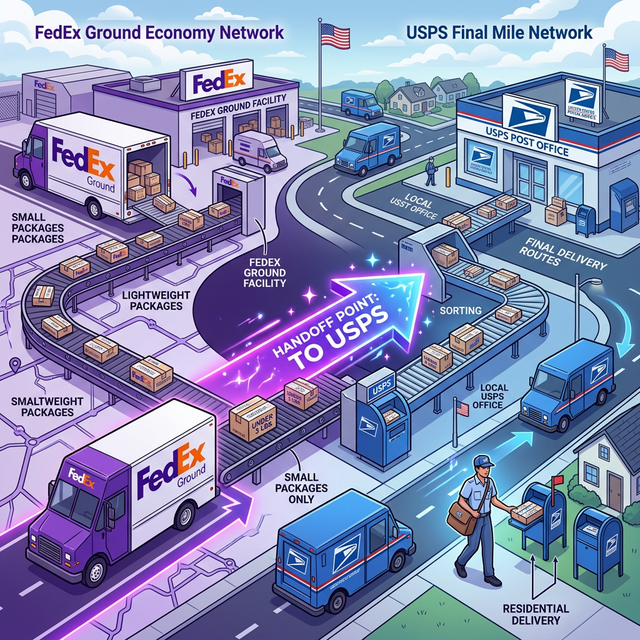
FedEx Ground Economy — formerly known as FedEx SmartPost — is a hybrid service where FedEx handles pickup, sorting, and regional transportation, then transfers packages to the U.S. Postal Service (USPS) for final delivery. It’s FedEx’s answer to UPS SurePost.
The USPS last-mile handoff is what makes Ground Economy the cheapest FedEx service for lightweight residential shipments.
Ground Economy vs. Standard Ground
| Feature | FedEx Ground Economy | FedEx Ground |
|---|---|---|
| Last-mile delivery | USPS | FedEx driver |
| Transit time | 2–7 business days | 1–5 business days |
| Maximum weight | 70 lbs | 150 lbs |
| Residential surcharge | None | $6.95 |
| DAS surcharge | None (USPS delivery) | $4.10–$7.75 |
| Tracking | FedEx + USPS | Full FedEx |
| Service guarantee | No | No |
Pricing Advantage
Ground Economy provides the biggest savings on lightweight, residential packages:
Example: 5 lb package, Zone 5, residential
| Service | Base | Fuel (8.5%) | Residential | Total |
|---|---|---|---|---|
| FedEx Ground | $12.10 | $1.03 | $6.95 | $20.08 |
| FedEx Ground Economy | $7.50 | $0.64 | $0.00 | $8.14 |
| Savings | $11.94 (59%) |
For lightweight residential packages, Ground Economy can cost half of standard Ground or less.
Weight and Size Limits
| Parameter | Ground Economy |
|---|---|
| Maximum weight | 70 lbs |
| Maximum length | 60 inches |
| Maximum L + girth | 130 inches |
| Minimum weight | No minimum |
Transit Time Trade-Off
Ground Economy is 1–3 days slower than standard Ground:
| Zone | Ground Transit | Ground Economy Transit |
|---|---|---|
| Zone 2 | 1–2 days | 2–4 days |
| Zone 5 | 3–4 days | 4–6 days |
| Zone 8 | 5 days | 6–8 days |
The transit time variability increases with distance, as the USPS handoff adds processing time.
Consolidation Points
FedEx Ground Economy operates through a network of USPS injection points — FedEx facilities where packages are sorted and transferred to USPS in bulk. The package may be injected at different points in the USPS network depending on the destination:
- Origin entry: Injected at the origin USPS facility → longest USPS transit
- Destination entry: Transported by FedEx to the destination region, then injected → shortest USPS transit
FedEx optimizes the injection point based on cost and transit time.
Ground Economy vs. UPS SurePost
| Feature | FedEx Ground Economy | UPS SurePost |
|---|---|---|
| Max weight | 70 lbs | 70 lbs |
| Max length | 60” | 60” |
| Pricing | Competitive | Competitive |
| Diversion risk | Lower | Higher |
| USPS handoff tracking | Similar | Similar |
| Availability | Most accounts | Most accounts |
Both services are very similar in structure and pricing. The main differences are:
- UPS SurePost has a higher diversion rate — UPS more aggressively diverts packages to UPS drivers, potentially charging Ground rates
- FedEx Ground Economy tends to have more predictable pricing
When to Use Ground Economy
Best For
- Lightweight residential packages (< 10 lbs)
- DAS/Extended Area destinations (eliminates DAS surcharge)
- Non-urgent shipments where 1–3 extra days is acceptable
- High-volume e-commerce with cost-sensitive fulfillment
Not Ideal For
- Time-sensitive deliveries
- Heavy packages (> 10 lbs — diminishing savings)
- Commercial addresses (Ground Economy is for residential)
- Shipments requiring strong end-to-end tracking
The Bottom Line
FedEx Ground Economy is the lowest-cost option in the FedEx portfolio for lightweight residential shipments. By eliminating the residential surcharge, DAS, and providing lower base rates, savings of 40–60% vs. standard Ground are achievable. The trade-off is slower transit and less tracking visibility — acceptable for many e-commerce fulfillment scenarios.
Want to see how Ground Economy compares to your current service mix? Upload one invoice to ShipMint’s Instant Analysis — free.