What Is Dimensional Weight?
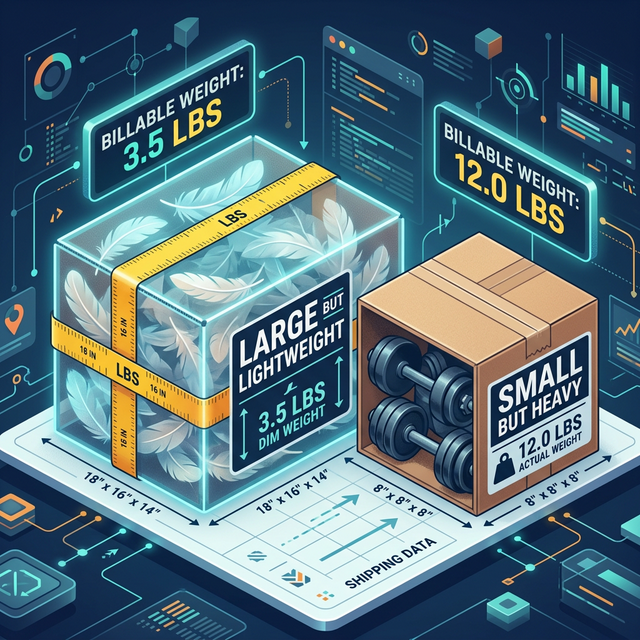
Dimensional weight (DIM weight) is a pricing method that accounts for a package’s size rather than just its actual weight. Carriers use DIM weight because large, lightweight packages take up valuable truck and aircraft space without generating proportional revenue from actual weight alone.
The concept is straightforward: if a package is bulky relative to its weight, the carrier charges based on the space it occupies rather than what it weighs on a scale.
The DIM Weight Formula
Both UPS and FedEx use the same formula for domestic shipments:
DIM Weight (lbs) = (Length × Width × Height) ÷ 139
All measurements are in inches. The result is rounded up to the next whole pound.
The number 139 is the DIM divisor (also called the DIM factor). A lower divisor produces a higher DIM weight, meaning you’d pay more. International shipments often use a divisor of 139 as well, although some carriers use different divisors for specific international services.
How DIM Weight Affects Your Bill
Carriers charge based on the greater of actual weight or DIM weight. This is called the billable weight.
Example 1: DIM Weight Wins
A box measuring 20” × 16” × 12” that weighs 6 lbs:
- DIM weight: (20 × 16 × 12) ÷ 139 = 27.6 → 28 lbs
- Actual weight: 6 lbs
- Billable weight: 28 lbs (DIM weight wins)
You’re paying for 28 lbs of shipping on a 6 lb package. That’s a 4.7× cost multiplier compared to what you’d expect.
Example 2: Actual Weight Wins
A box measuring 10” × 8” × 6” that weighs 12 lbs:
- DIM weight: (10 × 8 × 6) ÷ 139 = 3.5 → 4 lbs
- Actual weight: 12 lbs
- Billable weight: 12 lbs (Actual weight wins)
In this case, the package is dense enough that actual weight exceeds DIM weight. No DIM penalty here.
The DIM Breakeven Point
For any given box size, there’s a specific actual weight where DIM stops costing you extra. This is the DIM breakeven — the weight at or above which actual weight exceeds DIM weight.
| Box Size (L × W × H) | DIM Weight (lbs) | Breakeven |
|---|---|---|
| 12 × 10 × 8 | 7 | 7 lbs |
| 16 × 12 × 10 | 14 | 14 lbs |
| 18 × 14 × 12 | 22 | 22 lbs |
| 20 × 16 × 14 | 33 | 33 lbs |
| 24 × 18 × 16 | 50 | 50 lbs |
| 30 × 20 × 18 | 78 | 78 lbs |
If your product weighs less than the DIM weight for its box, you’re paying a DIM penalty.
What Percentage of Shipments Are DIM-Affected?
Across ShipMint’s dataset, approximately 35–55% of packages are billed at DIM weight rather than actual weight. For e-commerce shippers — who often use oversized boxes with void fill — the DIM rate can reach 60–70%.
This means the majority of shipments for many businesses are priced not by what’s inside the box, but by the size of the box itself.
How to Reduce DIM Weight Charges
1. Right-Size Your Packaging
The single most impactful change. Use the smallest box that safely fits your product with appropriate cushioning. If you have 5 stock box sizes, consider adding intermediate sizes to fill gaps.
2. Custom-Fit Packaging
Companies like Packsize and Ranpak offer on-demand packaging systems that create custom-sized boxes for each order, eliminating empty space.
3. Use Poly Mailers and Flexible Packaging
For soft goods, apparel, and non-fragile items, poly mailers effectively eliminate DIM weight since they conform to the product shape.
4. Negotiate a Higher DIM Divisor
Some high-volume shippers negotiate a DIM divisor higher than 139 (e.g., 166 or 194) in their carrier agreement. This reduces the calculated DIM weight and can yield significant savings.
| DIM Divisor | DIM Weight (20×16×12 box) | Savings vs. 139 |
|---|---|---|
| 139 | 28 lbs | — |
| 166 | 24 lbs | 14% |
| 194 | 20 lbs | 29% |
5. Audit Your Invoices
Carrier measurement systems occasionally overstate package dimensions. Regular audits can catch these errors and recover credits.
The Bottom Line
Dimensional weight pricing is one of the largest — and most controllable — cost drivers in parcel shipping. If more than 40% of your shipments are DIM-affected, packaging optimization should be a top priority. A simple box resize can save 15–30% on the affected shipments without changing carriers, negotiating rates, or doing anything else.
Want to know what percentage of your shipments are DIM-affected? Upload one invoice to ShipMint’s Instant Analysis and see your DIM weight breakdown instantly — free.