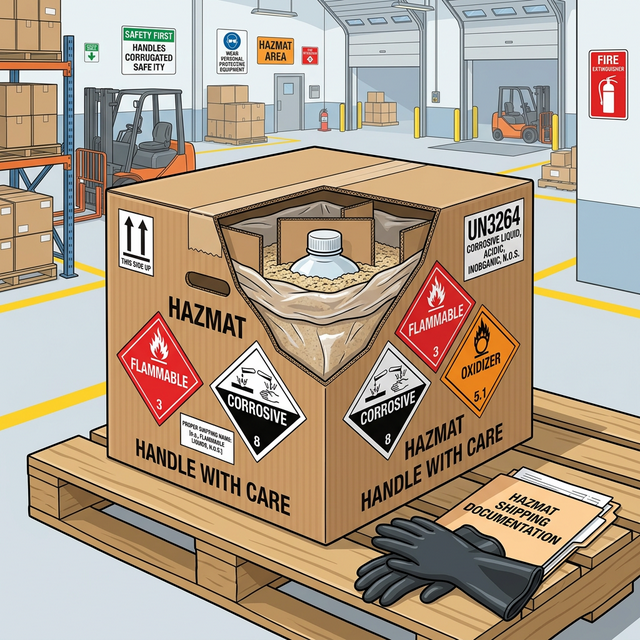
What Are Dangerous Goods?
Dangerous goods (DG) — also called hazardous materials (hazmat) — are products that pose a risk to people, property, or the environment during transportation. Both UPS and FedEx accept certain categories of DG shipments, but with significant restrictions, additional packaging requirements, and surcharges.
Dangerous Goods Classifications
The Department of Transportation (DOT) and International Air Transport Association (IATA) classify dangerous goods into 9 classes:
| Class | Category | Common Examples |
|---|---|---|
| 1 | Explosives | Ammunition, fireworks, flares |
| 2 | Gases | Aerosol sprays, propane, CO₂ cartridges |
| 3 | Flammable Liquids | Perfume, nail polish remover, paint |
| 4 | Flammable Solids | Matches, magnesium, activated carbon |
| 5 | Oxidizers & Peroxides | Pool chemicals, bleach, hydrogen peroxide |
| 6 | Toxic & Infectious | Pesticides, medical specimens |
| 7 | Radioactive | Smoke detectors, medical isotopes |
| 8 | Corrosives | Batteries (acid-filled), cleaning agents |
| 9 | Miscellaneous DG | Lithium batteries, dry ice, magnetized materials |
Class 9 is the most commonly shipped by e-commerce businesses, primarily due to lithium batteries in electronics.
Hazmat Surcharges
2026 Dangerous Goods Surcharges
| Carrier | DG Surcharge (Fully Regulated) | DG Surcharge (Limited Quantity) |
|---|---|---|
| UPS | $45.00 per package | $0.00 (no surcharge) |
| FedEx | $50.00 per package | $0.00 (no surcharge) |
Lithium Battery Surcharges
Lithium batteries have their own specific fee structure:
| Battery Type | Shipment Method | Surcharge |
|---|---|---|
| Lithium-ion (packed with equipment) | Ground | Varies by carrier |
| Lithium-ion (standalone) | Ground only | $5.00–$12.50 |
| Lithium metal (any) | Ground only (restrictions) | $5.00–$12.50 |
Air restrictions: Standalone lithium batteries are generally prohibited on passenger aircraft and heavily restricted on cargo aircraft.
Packaging Requirements
Dangerous goods shipments must meet specific packaging standards:
UN-Specification Packaging
Fully regulated DG shipments require UN-spec packaging — tested and certified containers that meet DOT/IATA performance standards. These include:
- Drop tests (from specific heights)
- Stacking tests
- Vibration tests
- Pressure tests (for liquids)
Limited Quantity Exemptions
Many products qualify as “limited quantity” (LQ) shipments when the per-package amount falls below regulatory thresholds. LQ shipments:
- Don’t require UN-spec packaging
- Don’t incur DG surcharges
- Do require proper marking (diamond-shaped LQ label)
- Can ship via air and ground
Common Limited Quantity Items
- Small perfume bottles (< 30 ml)
- Nail polish (< 30 ml)
- Aerosol cans (< 1 L)
- Hand sanitizer (< 500 ml)
- Small lithium battery devices (< 100 Wh)
Documentation Requirements
Shipper’s Declaration for Dangerous Goods
Fully regulated DG shipments require a completed Shipper’s Declaration that includes:
- Proper shipping name and UN number
- Class and division
- Packing group
- Quantity and net weight
- Emergency contact information
Training Requirements
Both DOT and IATA require that anyone involved in shipping dangerous goods must receive hazmat training and recertification every 2–3 years. This includes:
- Warehouse workers who pack DG shipments
- Shipping clerks who prepare documentation
- Managers who oversee DG operations
What You Can and Can’t Ship
Commonly Prohibited (No exceptions)
- Class 1 explosives (fireworks, ammunition via air)
- Poisonous gases
- Infectious substances (without proper medical shipping certification)
- Radioactive materials (without NRC license)
Commonly Accepted with Restrictions
- Aerosols (limited quantity)
- Perfume and cosmetics (limited quantity)
- Lithium batteries (with devices, under size limits)
- Dry ice (with proper packaging and marking)
- Small amounts of flammable liquids (limited quantity)
The Bottom Line
Dangerous goods shipping adds complexity and cost, but many common products — perfumes, electronics with lithium batteries, aerosol cosmetics — qualify for limited quantity exemptions that avoid the $45–$50 surcharge. The key is correctly classifying your products, training your team, and using the right packaging. Getting it wrong can result in fines, refused shipments, and liability issues.
Shipping hazmat and want to track those surcharges? Upload one invoice to ShipMint’s Instant Analysis for a complete surcharge audit — free.